Menu Close

Solo Holiday Feast Formats

Save

Trend-Name

Solo Holiday Feast Formats

Trend-Categorie

  • Food Trend

Trend-Description

Korean convenience chains are splitting traditional holiday feasts into single-person ready meals, gimbap, rice balls and side-dish packs. CU, GS25, 7-Eleven and Emart24 package bulgogi, japchae, jeon, namul and songpyeon for compact solo celebrations.

Example

Wow factor or special feature

Full festive spreads shrink into single-person, grab-and-go meal architectures.

Origin

  • Asia

Last Buzz Year

2026

Last Buzz Month

9

Best Reach

4

Best Novelty

6

Best Longevity

8

Best Market Impact

4

Best Trend Score

22

Current Reach

4

Current Novelty

6

Current Longevity

8

Current Market Impact

4

Current Trend Score

22

Monitoring Status

  • Active

Solo Holiday Feast Formats

Consumer TrendNiche CuriosityCooling −3

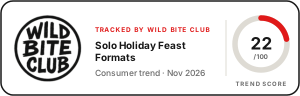
Solo Holiday Feast Formats is a Niche Curiosity consumer trend with a WBC Trend Score of 22/100 (October 2026).

The score

22/100 Peak 25
Reach 4/25 Very limited awareness
Novelty 6/25 Barely new
Longevity 8/25 Short-term relevance
Market Impact 4/25 Mostly PR-led

Key takeaways

Niche Curiosity: Longevity leads the profile, while reach holds it back.

Why it matters nowThe latest reassessment moved the score lower, making the next evidence important for judging whether momentum is fading or stabilising.

What changedReach −2 · Novelty +3 · Longevity +1 · Market Impact −5

Watch nextWider distribution, recurring launches and visibility beyond specialist or novelty-driven audiences.

Who should careBrand strategists, retailers, category teams and consumer insight specialists.

WBC Verdict

A selective opportunity rather than a mass-market move. Test narrowly and watch for repeat demand.

Analysis

What this trend means

Korean convenience chains are splitting traditional holiday feasts into single-person ready meals, gimbap, rice balls and side-dish packs. CU, GS25, 7-Eleven and Emart24 package bulgogi, japchae, jeon, namul and songpyeon for compact solo celebrations.

Full festive spreads shrink into single-person, grab-and-go meal architectures. This consumer trend is best read as a Niche Curiosity. The score pattern supports a narrowly defined idea rather than evidence of broad adoption. Its roots point to Asia. Its latest recorded development is cooling. The most recent dated signal is from September 2026.

The profile leans on longevity; reach is where it falls short. Even the leading dimension remains a relative strength rather than a strong market signal. The recorded consumer drivers are Convenience, Experience & Discovery and Value. The latest recorded change is explained by this signal: Solo holiday feast formats maintain a national niche in Korea with recurring post-season convenience store adoption.

Score history

Losing ground since October

WBC Trend Score · scale 0–100

Now 22 Peak 25 1 recorded change

10050Oct 28Oct 29Peak 2512210050Oct 28Oct 29Peak 25122
  1. −3 25 → 22

    Solo holiday feast formats maintain a national niche in Korea with recurring post-season convenience store adoption.

Source: WBC Trend Score archive · recorded snapshots

Trend runway · remaining relevance

Seasonal cycle This trend moves with the season: relevance is expected to build and fade around September each year rather than decline steadily. Season-led trajectory. A conditional baseline based on WBC's decay model, not a demand forecast.

Seasonal calendar

Returns in September
  1. J
  2. F
  3. M
  4. A
  5. M
  6. J
  7. J
  8. A
  9. S
  10. O
  11. N
  12. D
Expected to regain relevance in September. The return is seasonal, so renewed attention should be judged against the previous peak rather than off-season visibility.

Outlook

Commercial outlook

For brand strategists, retailers, category teams and consumer insight specialists, Reach and Market Impact are the decisive commercial signals. Together, these values do not yet support a broad or readily scalable opportunity. The evidence is better suited to a controlled launch, a seasonal activation or a narrowly defined category test than to wide distribution. The resulting assessment is Limited Commercial Signal: Commercial potential remains confined to narrow or activation-led use cases.

What would move the needle: wider distribution, recurring launches and visibility beyond specialist or novelty-driven audiences. If that improves and the total score rises across more than one assessment, the case for expansion gets stronger. Its runway is seasonal rather than linear; the conditional pattern is shown above. Expected to regain relevance in September. The return is seasonal, so renewed attention should be judged against the previous peak rather than off-season visibility.

Quick answers

Frequently asked questions

Is Solo Holiday Feast Formats still a trend in 2026?

Yes, but it is cooling. The latest WBC reassessment removed 3 points; Solo Holiday Feast Formats now scores 22/100.

What is the Solo Holiday Feast Formats trend score?

Solo Holiday Feast Formats has a WBC Trend Score of 22/100 (updated Oct 29, 2026). It combines Reach (4/25), Novelty (6/25), Longevity (8/25) and Market Impact (4/25). Its recorded peak is 25/100.

What kind of trend is Solo Holiday Feast Formats?

WBC classifies Solo Holiday Feast Formats as a Niche Curiosity: The score pattern supports a narrowly defined idea rather than evidence of broad adoption. Commercially, it is rated "Limited Commercial Signal": Commercial potential remains confined to narrow or activation-led use cases.

Who should care about Solo Holiday Feast Formats?

Brand strategists, retailers, category teams and consumer insight specialists. A selective opportunity rather than a mass-market move. Test narrowly and watch for repeat demand.

What could change the outlook for Solo Holiday Feast Formats?

Its weakest dimension is reach. The outlook would improve with wider distribution, recurring launches and visibility beyond specialist or novelty-driven audiences.

Keep exploring