Menu Close

RTD Yerba Mate Energy

Save

Trend-Name

RTD Yerba Mate Energy

Trend-Categorie

  • Food Trend

Trend-Description

Yerba mate is shifting from shared gourd ritual into canned, flavored energy drinks, positioned as smoother natural caffeine for social, sporty and workday occasions.

Example

Wow factor or special feature

South American ritual becomes a clean-energy can for global shelves.

Origin

  • South America

Last Buzz Year

2026

Last Buzz Month

6

Best Reach

10

Best Novelty

6

Best Longevity

12

Best Market Impact

8

Best Trend Score

36

Current Reach

7

Current Novelty

2

Current Longevity

14

Current Market Impact

7

Current Trend Score

30

Monitoring Status

  • Active

RTD Yerba Mate Energy

Beverage TrendSlow BuilderBelow peak

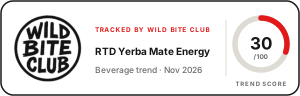
RTD Yerba Mate Energy is a Slow Builder beverage trend with a WBC Trend Score of 30/100 (November 2026).

The score

30/100 Peak 36 · August 2026
Reach 7/25 Very limited awareness
Novelty 2/25 Copy of known ideas
Longevity 14/25 Likely relevant for 1–3 years
Market Impact 7/25 Mostly PR-led

Key takeaways

Slow Builder with Longevity as the strongest current signal and novelty as the main constraint.

Why it matters nowThe trend remains below its recorded peak, so renewed momentum would need fresh evidence rather than historical strength alone.

What changedNovelty −1

Watch nextMeaningful format innovation that goes beyond cosmetic extensions of familiar products.

Who should careBeverage developers, drinks brands, operators, retailers and ingredient suppliers.

WBC Verdict

Worth a targeted test; scale only once repeat demand shows up.

Analysis

What this trend means

Yerba mate is shifting from shared gourd ritual into canned, flavored energy drinks, positioned as smoother natural caffeine for social, sporty and workday occasions.

South American ritual becomes a clean-energy can for global shelves. WBC classifies this beverage trend as a Slow Builder. Staying power is developing ahead of broad visibility. Its roots point to South America. Its latest recorded development is below its historical peak. The most recent dated signal is from June 2026.

Longevity is currently the strongest dimension, while novelty is the main constraint. The recorded consumer drivers are Convenience, Experience & Discovery, Health and Performance. The latest recorded change is explained by this signal: Novelty fell by 1 point. Across the recorded assessments, the score has moved down overall.

Score history

Easing since August

WBC Trend Score · scale 0–100

Now 30 Peak 36 6 recorded changes

10050Aug 9SepOctNovNov 141234563010050Aug 9SepOctNovNov 1412345630
  1. +3 33 → 36

    The trend has transitioned from a niche experiment to a stable, multi-operator category with consistent product launches and sustained consumer interest.

  2. −5 36 → 31

    The trend has transitioned from a niche novelty to a stable, established functional beverage segment with consistent, albeit moderate, commercial activity.

  3. −1 31 → 30

    Novelty fell by 1 point.

  4. +2 30 → 32

    The trend shows sustained commercial activity and national niche presence with recent product launches reinforcing its position as a stable alternative in the energy beverage market.

  5. −1 32 → 31

    Novelty fell by 1 point.

  6. −1 31 → 30

    Novelty fell by 1 point.

Source: WBC Trend Score archive · recorded snapshots

Trend runway · remaining relevance

About 8 months Estimated time until the WBC Trend Score falls below the 15-point activity cut-off if no new positive evidence appears. Next modeled step: 30 → 28 around Nov 2026. A conditional baseline based on WBC's decay model, not a demand forecast.

Outlook

Commercial outlook

Commercially, beverage developers, drinks brands, operators, retailers and ingredient suppliers should look first at Reach and Market Impact. At these levels, the case for wide distribution is not there yet. A limited edition, seasonal activation or tightly scoped category test fits the evidence better. The resulting assessment is Limited Commercial Signal: Commercial potential remains confined to narrow or activation-led use cases.

The key evidence still missing is meaningful format innovation that goes beyond cosmetic extensions of familiar products. Improvement there, followed by a higher total score in more than one assessment, would strengthen the case for expansion. Without fresh positive evidence, the current trajectory points to gradual decline; the conditional runway is shown above.

Quick answers

Frequently asked questions

Is RTD Yerba Mate Energy still a trend in 2026?

Yes. RTD Yerba Mate Energy is actively monitored by WBC with a current Trend Score of 30/100 (recorded peak: 36).

What is the RTD Yerba Mate Energy trend score?

RTD Yerba Mate Energy has a WBC Trend Score of 30/100 (updated Nov 14, 2026). It combines Reach (7/25), Novelty (2/25), Longevity (14/25) and Market Impact (7/25). Its recorded peak is 36/100.

What kind of trend is RTD Yerba Mate Energy?

WBC classifies RTD Yerba Mate Energy as a Slow Builder: Staying power is developing ahead of broad visibility. Commercially, it is rated "Limited Commercial Signal": Commercial potential remains confined to narrow or activation-led use cases.

Who should care about RTD Yerba Mate Energy?

Beverage developers, drinks brands, operators, retailers and ingredient suppliers. Worth a targeted test; scale only once repeat demand shows up.

What could change the outlook for RTD Yerba Mate Energy?

Its weakest dimension is novelty. The outlook would improve with meaningful format innovation that goes beyond cosmetic extensions of familiar products.

Keep exploring