Menu Close

Australian Health-Halo Label Backlash

Save

Trend-Name

Australian Health-Halo Label Backlash

Trend-Categorie

  • Food Trend

Trend-Description

Australian scrutiny of ultra-processed packaging is making health-star ratings, natural claims and added fiber or protein cues a sharper consumer filter, pressuring FMCG teams to rethink front-of-pack trust and reformulation stories.

Example

Wow factor or special feature

Health claims become a trust risk, not just a sales cue.

Origin

  • Oceania

Last Buzz Year

2026

Last Buzz Month

8

Best Reach

8

Best Novelty

6

Best Longevity

15

Best Market Impact

7

Best Trend Score

36

Current Reach

7

Current Novelty

5

Current Longevity

15

Current Market Impact

7

Current Trend Score

34

Monitoring Status

  • Active

Australian Health-Halo Label Backlash

Consumer TrendSlow BuilderBelow peak

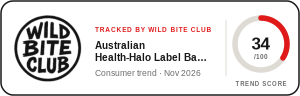
Australian Health-Halo Label Backlash is a Slow Builder consumer trend with a WBC Trend Score of 34/100 (November 2026).

The score

34/100 Peak 36 · September 2026
Reach 7/25 Very limited awareness
Novelty 5/25 Barely new
Longevity 15/25 Likely relevant for 1–3 years
Market Impact 7/25 Mostly PR-led

Key takeaways

Slow Builder with Longevity as the strongest current signal and novelty as the main constraint.

Why it matters nowThe trend remains below its recorded peak, so renewed momentum would need fresh evidence rather than historical strength alone.

What changedReach −1 · Novelty +1

Watch nextMeaningful format innovation that goes beyond cosmetic extensions of familiar products.

Who should careBrand strategists, retailers, category teams and consumer insight specialists.

WBC Verdict

Worth a targeted test; scale only once repeat demand shows up.

Analysis

What this trend means

Australian scrutiny of ultra-processed packaging is making health-star ratings, natural claims and added fiber or protein cues a sharper consumer filter, pressuring FMCG teams to rethink front-of-pack trust and reformulation stories.

Health claims become a trust risk, not just a sales cue. In WBC terms, this consumer trend is a Slow Builder. Staying power is developing ahead of broad visibility. The signal is associated with Oceania. Its latest recorded development is below its historical peak. The most recent dated signal is from August 2026.

Longevity is currently the strongest dimension, while novelty is the main constraint. The recorded consumer driver is Health. The latest recorded change is explained by this signal: The trend reflects a sustained shift in Australian consumer sentiment toward skepticism of health-halo marketing, supported by ongoing media scrutiny and public discourse. The available scoring history shows a net downward direction.

Score history

Holding its level since August

WBC Trend Score · scale 0–100

Now 34 Peak 36 5 recorded changes

10050Aug 20SepOctNovNov 19123453410050Aug 20SepOctNovNov 191234534
  1. −3 34 → 31

    The trend reflects a maturing consumer skepticism toward health-halo claims, moving from niche awareness to active scrutiny of FMCG labeling practices in Australia and beyond.

  2. +1 31 → 32

    The trend has evolved from academic scrutiny to a mainstream consumer filter, with Gen Z skepticism driving active pushback against health-halo marketing in Australia.

  3. +4 32 → 36

    The trend has matured from academic discourse into a mainstream consumer filter in Australia, driving tangible skepticism toward front-of-pack health claims and forcing FMCG accountability.

  4. −1 36 → 35

    Novelty fell by 1 point.

  5. −1 35 → 34

    Novelty fell by 1 point.

Source: WBC Trend Score archive · recorded snapshots

Trend runway · remaining relevance

About 10 months Estimated time until the WBC Trend Score falls below the 15-point activity cut-off if no new positive evidence appears. Next modeled step: 34 → 33 around Dec 2026. A conditional baseline based on WBC's decay model, not a demand forecast.

Outlook

Commercial outlook

For brand strategists, retailers, category teams and consumer insight specialists, Reach and Market Impact are the decisive commercial signals. Together, these values do not yet support a broad or readily scalable opportunity. The evidence is better suited to a controlled launch, a seasonal activation or a narrowly defined category test than to wide distribution. The resulting assessment is Limited Commercial Signal: Commercial potential remains confined to narrow or activation-led use cases.

What would move the needle: meaningful format innovation that goes beyond cosmetic extensions of familiar products. Improvement there, followed by a higher total score in more than one assessment, would strengthen the case for expansion. Without fresh positive evidence, the current trajectory points to gradual decline; the conditional runway is shown above.

Quick answers

Frequently asked questions

Is Australian Health-Halo Label Backlash still a trend in 2026?

Yes. Australian Health-Halo Label Backlash is actively monitored by WBC with a current Trend Score of 34/100 (recorded peak: 36).

What is the Australian Health-Halo Label Backlash trend score?

Australian Health-Halo Label Backlash has a WBC Trend Score of 34/100 (updated Nov 19, 2026). It combines Reach (7/25), Novelty (5/25), Longevity (15/25) and Market Impact (7/25). Its recorded peak is 36/100.

What kind of trend is Australian Health-Halo Label Backlash?

WBC classifies Australian Health-Halo Label Backlash as a Slow Builder: Staying power is developing ahead of broad visibility. Commercially, it is rated "Limited Commercial Signal": Commercial potential remains confined to narrow or activation-led use cases.

Who should care about Australian Health-Halo Label Backlash?

Brand strategists, retailers, category teams and consumer insight specialists. Worth a targeted test; scale only once repeat demand shows up.

What could change the outlook for Australian Health-Halo Label Backlash?

Its weakest dimension is novelty. The outlook would improve with meaningful format innovation that goes beyond cosmetic extensions of familiar products.

Keep exploring