Menu Close

M&S Foodhall Advent Calendar

Save

Trend-Name

M&S Foodhall Advent Calendar

Trend-Categorie

  • Food Trend

Trend-Description

M&S compresses its Foodhall into a 25-door calendar containing chocolate, pantry products, cocktails, panettone and Champagne. Strong launch coverage and shopper demand emptied the £100 calendar within 72 hours, turning a seasonal gift into an unusually early scarcity event.

Example

Wow factor or special feature

Twenty-seven full food and drink products sell out three months before Christmas.

Origin

  • Europe

Last Buzz Year

2026

Last Buzz Month

10

Best Reach

8

Best Novelty

7

Best Longevity

8

Best Market Impact

4

Best Trend Score

27

Current Reach

8

Current Novelty

7

Current Longevity

8

Current Market Impact

4

Current Trend Score

27

Monitoring Status

  • Active

M&S Foodhall Advent Calendar

Consumer TrendNiche CuriosityCooling −4

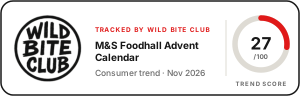
M&S Foodhall Advent Calendar is a Niche Curiosity consumer trend with a WBC Trend Score of 27/100 (November 2026).

The score

27/100 Peak 31
Reach 8/25 Niche visibility
Novelty 7/25 Barely new
Longevity 8/25 Short-term relevance
Market Impact 4/25 Mostly PR-led

Key takeaways

A Niche Curiosity profile — strongest on reach, weakest on market impact.

Why it matters nowThe score slipped in the latest assessment; the next data point will show whether this is a dip or a turn.

What changedReach −2 · Longevity +3 · Market Impact −5

Watch nextClear price acceptance, scalable margins and investment beyond publicity-led pilots.

Who should careBrand strategists, retailers, category teams and consumer insight specialists.

WBC Verdict

Worth a targeted test; scale only once repeat demand shows up.

Analysis

What this trend means

M&S compresses its Foodhall into a 25-door calendar containing chocolate, pantry products, cocktails, panettone and Champagne. Strong launch coverage and shopper demand emptied the £100 calendar within 72 hours, turning a seasonal gift into an unusually early scarcity event.

Twenty-seven full food and drink products sell out three months before Christmas. WBC classifies this consumer trend as a Niche Curiosity. The score pattern supports a narrowly defined idea rather than evidence of broad adoption. The signal is associated with Europe. Its latest recorded development is cooling. The most recent dated signal is from October 2026.

Reach is currently the strongest dimension, while market impact is the main constraint. Even the leading dimension remains a relative strength rather than a strong market signal. The recorded consumer drivers are Experience & Discovery and Indulgence. The latest recorded change is explained by this signal: Post-season evaluation reflects strong national retail presence and rapid sell-out that has now tapered off.

Score history

Losing ground since November

WBC Trend Score · scale 0–100

Now 27 Peak 31 1 recorded change

10050Nov 7Nov 8Peak 3112710050Nov 7Nov 8Peak 31127
  1. −4 31 → 27

    Post-season evaluation reflects strong national retail presence and rapid sell-out that has now tapered off.

Source: WBC Trend Score archive · recorded snapshots

Trend runway · remaining relevance

Seasonal cycle This trend moves with the season: relevance is expected to build and fade around October each year rather than decline steadily. Season-led trajectory. A conditional baseline based on WBC's decay model, not a demand forecast.

Seasonal calendar

Returns in October
  1. J
  2. F
  3. M
  4. A
  5. M
  6. J
  7. J
  8. A
  9. S
  10. O
  11. N
  12. D
Expected to regain relevance in October. The return is seasonal, so renewed attention should be judged against the previous peak rather than off-season visibility.

Outlook

Commercial outlook

For brand strategists, retailers, category teams and consumer insight specialists, Reach and Market Impact are the decisive commercial signals. Together, these values do not yet support a broad or readily scalable opportunity. The evidence is better suited to a controlled launch, a seasonal activation or a narrowly defined category test than to wide distribution. The resulting assessment is Limited Commercial Signal: Commercial potential remains confined to narrow or activation-led use cases.

What would move the needle: clear price acceptance, scalable margins and investment beyond publicity-led pilots. If that improves and the total score rises across more than one assessment, the case for expansion gets stronger. Its runway is seasonal rather than linear; the conditional pattern is shown above. Expected to regain relevance in October. The return is seasonal, so renewed attention should be judged against the previous peak rather than off-season visibility.

Quick answers

Frequently asked questions

Is M&S Foodhall Advent Calendar still a trend in 2026?

Yes, but it is cooling. The latest WBC reassessment removed 4 points; M&S Foodhall Advent Calendar now scores 27/100.

What is the M&S Foodhall Advent Calendar trend score?

M&S Foodhall Advent Calendar has a WBC Trend Score of 27/100 (updated Nov 8, 2026). It combines Reach (8/25), Novelty (7/25), Longevity (8/25) and Market Impact (4/25). Its recorded peak is 31/100.

What kind of trend is M&S Foodhall Advent Calendar?

WBC classifies M&S Foodhall Advent Calendar as a Niche Curiosity: The score pattern supports a narrowly defined idea rather than evidence of broad adoption. Commercially, it is rated "Limited Commercial Signal": Commercial potential remains confined to narrow or activation-led use cases.

Who should care about M&S Foodhall Advent Calendar?

Brand strategists, retailers, category teams and consumer insight specialists. Worth a targeted test; scale only once repeat demand shows up.

What could change the outlook for M&S Foodhall Advent Calendar?

Its weakest dimension is market impact. The outlook would improve with clear price acceptance, scalable margins and investment beyond publicity-led pilots.

Keep exploring