Menu Close

Cape Town Moving Dining Buses

Save

Trend-Name

Cape Town Moving Dining Buses

Trend-Categorie

  • Food Trend

Trend-Description

Cape Town’s dining-bus formats combine city views, hosted storytelling and plated tea or multi-course service, turning transport into a moving hospitality backdrop for birthdays, influencer visits and premium tourism content.

Example

Wow factor or special feature

A double-decker bus turns scenic travel into a premium dining set.

Origin

  • Africa

Last Buzz Year

2026

Last Buzz Month

6

Best Reach

4

Best Novelty

7

Best Longevity

9

Best Market Impact

5

Best Trend Score

25

Current Reach

2

Current Novelty

3

Current Longevity

10

Current Market Impact

3

Current Trend Score

18

Monitoring Status

  • Active

Cape Town Moving Dining Buses

Consumer TrendNiche CuriosityBelow peak

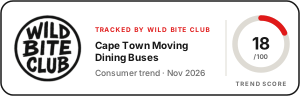
Cape Town Moving Dining Buses is a Niche Curiosity consumer trend with a WBC Trend Score of 18/100 (November 2026).

The score

18/100 Peak 30 · August 2026
Reach 2/25 No meaningful visibility
Novelty 3/25 Barely new
Longevity 10/25 Short-term relevance
Market Impact 3/25 Mostly PR-led

Key takeaways

A Niche Curiosity profile — strongest on longevity, weakest on reach.

Why it matters nowIt is trading below its best recorded level — past strength alone is not a reason to act now.

What changedNovelty −1

Watch nextWider distribution, recurring launches and visibility beyond specialist or novelty-driven audiences.

Who should careBrand strategists, retailers, category teams and consumer insight specialists.

WBC Verdict

A weak signal today: worth monitoring, but not strong enough for broad commercial action.

Analysis

What this trend means

Cape Town’s dining-bus formats combine city views, hosted storytelling and plated tea or multi-course service, turning transport into a moving hospitality backdrop for birthdays, influencer visits and premium tourism content.

A double-decker bus turns scenic travel into a premium dining set. In WBC terms, this consumer trend is a Niche Curiosity. The score pattern supports a narrowly defined idea rather than evidence of broad adoption. Its roots point to Africa. Its latest recorded development is below its historical peak. The most recent dated signal is from June 2026.

The profile leans on longevity; reach is where it falls short. Even the leading dimension remains a relative strength rather than a strong market signal. The recorded consumer drivers are Experience & Discovery and Indulgence. The latest recorded change is explained by this signal: Novelty fell by 1 point. Across the recorded assessments, the score has moved down overall.

Score history

Easing since August

WBC Trend Score · scale 0–100

Now 18 Peak 30 6 recorded changes

10050Aug 9SepOctNov 7Peak 301234561810050Aug 9SepOctNov 7Peak 3012345618
  1. −5 30 → 25

    The trend remains a localized niche experience in Cape Town with sustained but limited commercial activity and operator presence.

  2. −2 25 → 23

    The trend remains a niche, localized hospitality experience in Cape Town with limited operators and stable, long-term presence rather than broad market expansion.

  3. −1 23 → 22

    Novelty fell by 1 point.

  4. −1 22 → 21

    Novelty fell by 1 point.

  5. −2 21 → 19

    Reach fell by 1 point, while Market impact fell by 1 point.

  6. −1 19 → 18

    Novelty fell by 1 point.

Source: WBC Trend Score archive · recorded snapshots

Trend runway · remaining relevance

About 1 months Estimated time until the WBC Trend Score falls below the 15-point activity cut-off if no new positive evidence appears. Next modeled step: 18 → 17 around Dec 2026. A conditional baseline based on WBC's decay model, not a demand forecast.

Outlook

Commercial outlook

Commercially, brand strategists, retailers, category teams and consumer insight specialists should look first at Reach and Market Impact. At these levels, the case for wide distribution is not there yet. A limited edition, seasonal activation or tightly scoped category test fits the evidence better. The resulting assessment is Limited Commercial Signal: Commercial potential remains confined to narrow or activation-led use cases.

What would move the needle: wider distribution, recurring launches and visibility beyond specialist or novelty-driven audiences. Improvement there, followed by a higher total score in more than one assessment, would strengthen the case for expansion. Without fresh positive evidence, the current trajectory points to gradual decline; the conditional runway is shown above.

Quick answers

Frequently asked questions

Is Cape Town Moving Dining Buses still a trend in 2026?

Yes, but only as a weak signal. Cape Town Moving Dining Buses is still monitored by WBC with a Trend Score of 18/100.

What is the Cape Town Moving Dining Buses trend score?

Cape Town Moving Dining Buses has a WBC Trend Score of 18/100 (updated Nov 7, 2026). It combines Reach (2/25), Novelty (3/25), Longevity (10/25) and Market Impact (3/25). Its recorded peak is 30/100.

What kind of trend is Cape Town Moving Dining Buses?

WBC classifies Cape Town Moving Dining Buses as a Niche Curiosity: The score pattern supports a narrowly defined idea rather than evidence of broad adoption. Commercially, it is rated "Limited Commercial Signal": Commercial potential remains confined to narrow or activation-led use cases.

Who should care about Cape Town Moving Dining Buses?

Brand strategists, retailers, category teams and consumer insight specialists. A weak signal today: worth monitoring, but not strong enough for broad commercial action.

What could change the outlook for Cape Town Moving Dining Buses?

Its weakest dimension is reach. The outlook would improve with wider distribution, recurring launches and visibility beyond specialist or novelty-driven audiences.

Keep exploring